







Minister Bayraktar says important agreements were made at Gastech 2025 for natural gas supply security
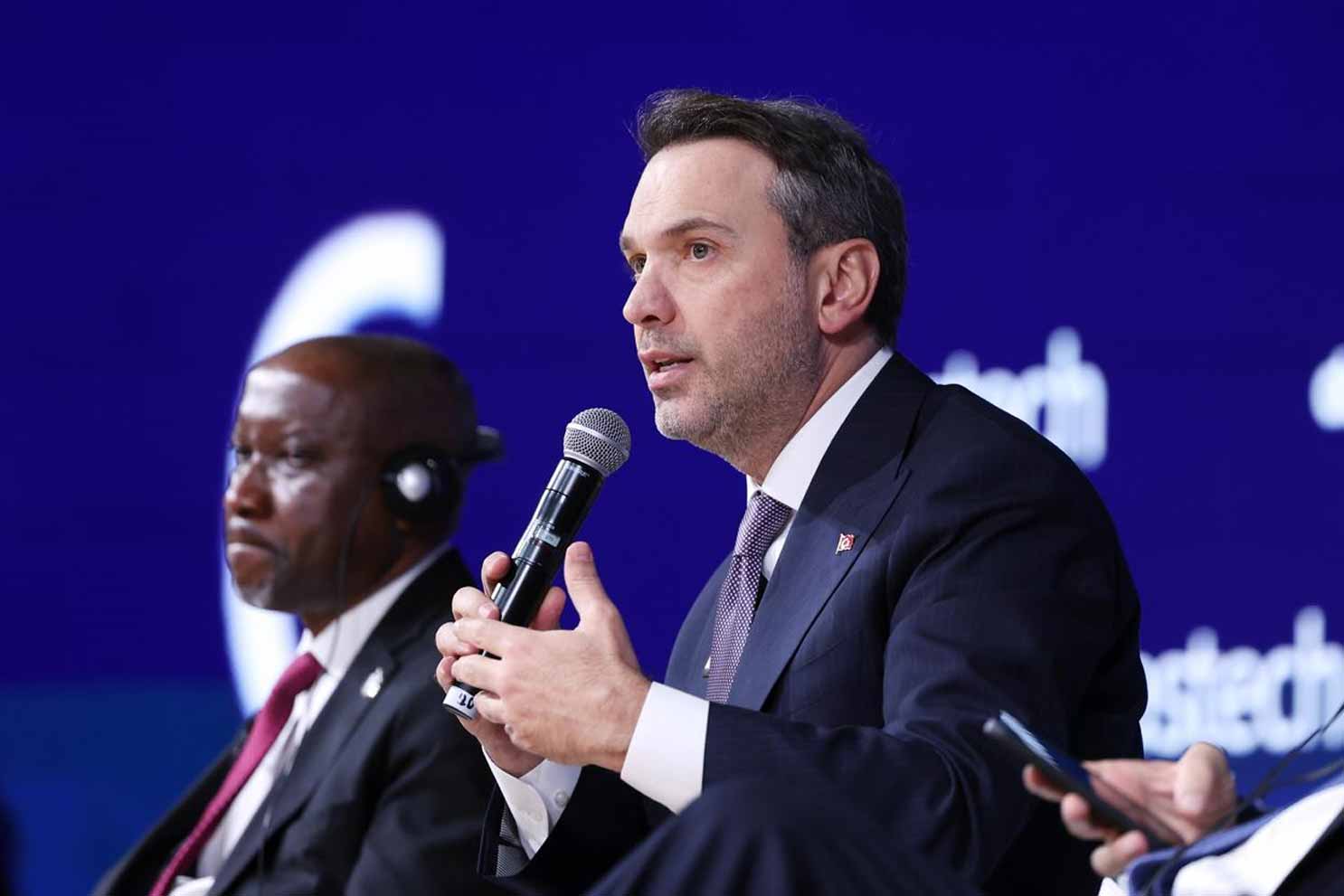
Minister of Energy and Natural Resources Alparslan Bayraktar stated that Türkiye made extremely important agreements for natural gas supply security within the scope of the Gastech 2025 Forum, and thanks to these agreements, liquefied natural gas will start arriving in the country as of November–December.
Petroturk | Enerji Haberleri
- 18 Eylül 2025 15:56
Minister of Energy and Natural Resources Alparslan Bayraktar stated that Türkiye made extremely important agreements for natural gas supply security within the scope of the Gastech 2025 Forum, and thanks to these agreements, liquefied natural gas will start arriving in the country as of November–December.
Minister of Energy and Natural Resources Alparslan Bayraktar, who came to Milan, Italy to attend the Gastech 2025 Forum, spoke to an AA correspondent about his contacts and Türkiye’s steps in the field of energy.
Bayraktar noted that they held many bilateral meetings and signed agreements on the margins of the conference, and continued as follows:
“In Türkiye, we especially attach great importance to natural gas in terms of resource diversity. However, in natural gas supply, along with our own investments — a process that began with our production in the Sakarya Gas Field — as well as investments we made abroad and diversifications in our supply portfolio, BOTAŞ has made important announcements to bring more competitive gas to Türkiye and to lower the cost of gas for our citizens.”
Bayraktar said that BOTAŞ signed agreements with companies from various countries this year, adding that at last year’s Gastech conference in Houston, USA, BOTAŞ made longer-term agreements.
The Minister stated that starting from this winter, BOTAŞ signed agreements with its counterparts for natural gas purchases amounting to around 15 billion cubic meters over a period of up to 3 years, mostly involving American LNG.
“I believe this will significantly contribute to diversity in BOTAŞ’s supply portfolio. From the perspective of our country’s supply security and natural gas supply security, we have made extremely important agreements. Beginning this winter, starting from November–December, liquefied natural gas will arrive in Türkiye within the scope of these agreements,” Bayraktar said. He emphasized that especially in the last eight years, after announcing the strategic document called the National Energy and Mining Policy, they made very significant infrastructure investments both domestically and in international pipelines, as well as in underground storage capacity.
Bayraktar continued:
“But most importantly, there has been an increase in regasification capacity, which is very significant and global in scale. Compared to 2016, Türkiye has achieved nearly a fivefold increase in regasification — in other words, the ability to bring LNG by ships and therefore natural gas from various alternatives — and this has brought us to where we are today.”
Thanks to this, he said they now see a major change in BOTAŞ’s portfolio and a much greater role for LNG, adding that these infrastructure investments have also made Türkiye an important supplier.
The Minister added:
“Every gas we bring to Türkiye, every gas we produce ourselves, and every surplus gas we create, we have now begun to export to different countries. As you know, within a very short time we interconnected the natural gas systems of Syria and Türkiye, and we started exporting gas from Azerbaijan to Syria. Likewise, right at the Iraqi border we now have a natural gas pipeline, and with developments there we may begin exporting gas to Iraq as well.”
He pointed out that with both existing pipeline projects and particularly the Türkiye–Bulgaria interconnection, as well as via Bulgaria to European countries, Türkiye has already begun exporting gas. “When we increase the abundance of gas in Türkiye, gas prices in the market will fall, and with the export of surplus gas, particularly to Europe, Türkiye will gain a significant advantage,” Bayraktar said.
The Minister stressed that Türkiye has important goals to break dependency on foreign energy and to become independent. He added that in this regard, there are projects carried out both on Türkiye’s land and in its “blue homeland.”
“Without excluding any energy source, Türkiye will use its domestic coal, search and produce its natural gas and oil. We must also integrate wind and solar at the highest level into our economy,” he said.
“THERE IS SIGNIFICANT ENERGY DEMAND, AND WE MUST MEET IT”
Bayraktar said one of the most important issues at the Gastech 2025 Forum was “the fact that global energy demand growth is exceeding projections,” and noted that this is also true for Türkiye.
“Our forecasts for 2050 indicate that Türkiye’s electricity needs will be three times today’s levels. However, new technologies, artificial intelligence, data centers, electric vehicles, electrification, and increasing electricity use in our buildings and across our economy will cause our electricity demand to grow beyond expectations. There is significant energy demand, and we must meet it,” he said.
Pointing out that climate change, global warming, and various weather events are also changing consumption habits, Bayraktar said that this year, during the extremely hot summer, there was abnormal electricity consumption and demand caused by excessive use of air conditioners.
“In this respect, we consider diversification — in terms of sources, routes, and supplier countries — extremely important,” he added.
Bayraktar noted that within the scope of the Gastech 2025 Forum, important agreements were signed regarding Türkiye’s natural gas production. He said that Phase 1 of the Sakarya Gas Field had been completed, Phase 2 was continuing, and that agreements signed by the Turkish Petroleum Offshore Technology Center (TP-OTC) regarding Phase 3 were extremely significant.
“In Phase 3 (of the Sakarya Gas Field), we signed agreements for the goal of quadrupling Türkiye’s current production by 2028. Agreements especially concerning subsea works and pipelines were finalized here,” Bayraktar said. He added that they want to bring this project into operation as soon as possible and move to planning for Phase 4 in 2030.
The Minister said that nearly 25 countries participated in the forum at ministerial level, and that he held meetings with U.S. Interior Secretary, particularly National Energy Sovereignty Council Chairman Doug Burgum, and U.S. Secretary of Energy Chris Wright.
“ENERGY COOPERATION BETWEEN THE U.S. AND TÜRKİYE IS PROGRESSING CONCRETELY THROUGH LNG SUPPLY”
Bayraktar said the main topic of his meetings was what could be done in the fields of energy and mining in line with the target set by President Recep Tayyip Erdoğan and U.S. President Donald Trump to increase trade volume between the two countries to 100 billion dollars.
He noted that they identified four areas where cooperation could be developed, one of which was nuclear energy.
“There is a great opportunity in both conventional, large-scale nuclear and small modular reactors. We have ambitious targets for 2050 here. We discussed cooperation in oil and natural gas. In fact, this is progressing concretely through LNG supply from the U.S. In addition, U.S. companies are partnering with TP-OTC in unconventional production methods that began in Diyarbakır. Likewise, we discussed turning oil and natural gas cooperation into joint projects in third countries outside Türkiye — we spoke with them about Libya, the Middle East, and different countries,” Bayraktar said.
He also pointed out that there are opportunities for cooperation in critical minerals, adding: “We will be in New York for the United Nations General Assembly. On that occasion, we may sign a few agreements, perhaps even a cooperation agreement in nuclear energy.”
Bayraktar noted that they also discussed infrastructure projects with U.S. counterparts, saying that Türkiye has very important goals regarding transmission lines.
“The goal we currently plan to achieve — quadrupling renewable energy by 2035 — is only possible with investments we will make in infrastructure. On these projects, we can work jointly with U.S. companies and financial institutions. Of course, we also had the opportunity to evaluate what we have done for Syria’s electricity and energy needs and what we can do together,” he said.


SON HABERLER
Pakistan, TPAO’nun sismik gemilerini sonbaharda karşılmaya hazırlanıyor5 Temmuz 202608:55 Rusya’nın Novorossiysk şehrinde benzinin bittiği bildirildi4 Temmuz 202615:00 Ulusal Yeşil Finans Stratejisi ve Eylem Planı’na ilişkin Cumhurbaşkanlığı Genelgesi Resmi Gazete’de4 Temmuz 202614:28 Sunar Yatırım’dan “Plastiksiz Temmuz” gündeminde geleceğe çağrı4 Temmuz 202611:30 Rosatom, Vietnam’da Katmanlı Üretim Teknolojileri Merkezi’nin kurulmasına destek verecek4 Temmuz 202610:00
Diğer Haberler